

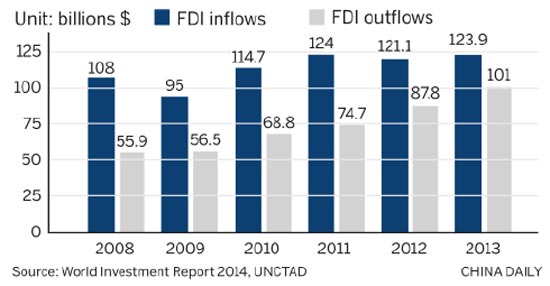
China's outward investment is very likely to exceed foreign direct investment inflows thisyear, making the country a net investor, according to officials at a United Nations body.
This "inevitable trend" will have "great significance in reshaping the economic structureand long-term development" of the world's second-largest economy, they said.
In 2013, China's foreign direct investment rose by 2.3 percent year-on-year to $123.9billion, ranking second in the world after the United States, according to the United NationsConference on Trade and Development's World Investment Report on Tuesday.
"China remained the recipient of the second-largest flows in the world. Meanwhile, thequality of FDI inflows improved, with more into high-end manufacturing and services withhigh added value," said Zhan Xiaoning, director of the Investment and Enterprise Divisionat UNCTAD.
"What's more, China's outward investment is more striking," Zhan said.
In 2013, investment outflows from China increased by 15 percent year-on-year to $101billion, the third highest in the world after the United States and Japan, the report said.
As China continues to deregulate outbound investment, outflows to developed anddeveloping countries are expected to grow further, it said.
Zhan said, "China's economic landscape, driven by exports and foreign investment in thepast three decades, will change significantly. Outward investment will serve as animportant driver for industrial upgrading and economic growth."
Liang Guoyong, an economic affairs officer at UNCTAD, said, "It is very hard to predictwhen China will become a net investor, but the trend is inevitable."
The process will accelerate along with the nation's fast economic growth, the increase inChinese companies' competitiveness and the amount of resources and market share theygain, Liang said.
The change will lead to a more effective allocation of financial resources for the Chineseeconomy, as the country holds the world's largest foreign exchange reserves, Liang added.
Huo Jianguo, president of the Chinese Academy of International Trade and EconomicCooperation, a Ministry of Commerce think tank, said China's new role as a net investorwill help ease trade frictions.
"The rapid increase in overseas investment by Chinese enterprises is very likely totransform the trade landscape, because profits from the overseas market will lessen thecountry's reliance on exports, reducing trade frictions and pressure from swelling foreignexchange reserves," Huo said.
